











































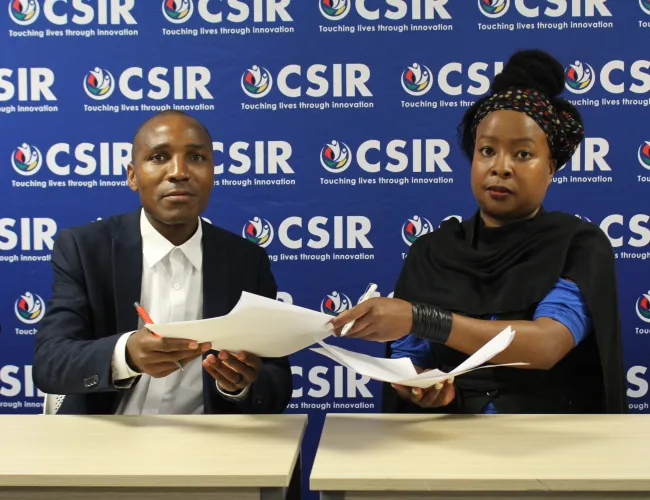
The Council for Scientific and Industrial Research (CSIR) has taken a major step in advancing South Africa’s bioeconomy after signing a pioneering Benefit-Sharing Agreement (BSA) with traditional knowledge – holding communities from Limpopo, Mpumalanga and KwaZulu-Natal for the commercialisation of African ginger technology.
The agreement, signed on 28 November 2025 at the CSIR’s Scientia Campus in Pretoria, formalises years of collaboration between scientists and indigenous communities and marks a significant milestone in ethical and inclusive bioprospecting.
Dr Rodney Managa, Research Group Leader for Agroprocessing at the CSIR, said the initiative demonstrates how science and indigenous knowledge can work together to drive sustainable development.
“This initiative underscores the transformative power of the bioeconomy in advancing the United Nations Sustainable Development Goals, especially Goal Three on good health and well-being, while contributing to South Africa’s National Development Plan 2030 and its vision of a knowledge-driven economy,” Managa said.
African ginger (Siphonochilus aethiopicus) has been used for generations in traditional medicine to treat respiratory conditions, stomach ailments, malaria and asthma.
Building on this indigenous knowledge, the CSIR has conducted extensive scientific research validating the plant’s therapeutic properties, particularly its potential in asthma treatment, paving the way for pharmaceutical development.
The CSIR confirmed that the agreement complies fully with the National Environmental Management: Biodiversity Act and South Africa’s Bioprospecting, Access and Benefit-Sharing regulations. These laws require that traditional knowledge holders are properly identified, consulted and fairly compensated when their knowledge is used for commercial purposes.
According to Managa, the agreement goes beyond regulatory compliance.
“The signing of the BSA signifies more than compliance; it represents a commitment to equity, recognition and empowerment. Benefits will flow back to the communities that have safeguarded this knowledge, strengthening local economies and small businesses,” Managa said.
The project has been supported by the United Nations Development Programme through Global Environment Facility Six funding, coordinated by the Department of Forestry, Fisheries and the Environment’s Bioprospecting, Access and Benefit-Sharing Unit. Additional support was provided by the University of Venda’s Directorate of Community Engagement, Entrepreneurship, Inclusive Innovation and Commercialisation.
Managa added that the agreement ensures that communities and their enterprises are recognised as partners rather than raw material suppliers.
With patents already secured and licensing discussions at an advanced stage, the CSIR is preparing to bring an African ginger–based product to market. A prospective commercial partner will be responsible for manufacturing, marketing and distribution, while ensuring that the supply chain remains environmentally responsible and does not threaten biodiversity.
The agreement is being viewed as a model for future bioprospecting initiatives in South Africa, demonstrating how scientific innovation, environmental protection and community empowerment can be aligned in the commercialisation of indigenous resources.
“The CSIR reinforces a model of innovation that honours heritage while fostering sustainable development,” he said.
Azwi@vutivibusiness.co.za