




























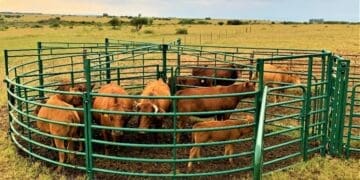

















Beef producers are being urged to rethink production systems and focus on profitability rather than animal size as climate pressure and market uncertainty continue to squeeze South Africa’s agricultural sector.
This message formed the core of discussions at the Red Meat Revolution Information Day held at Silverlakes Farm Hotel in Pretoria recently. This is where more than 300 producers, breeders and industry specialists gathered to examine practical ways of sustaining viable beef operations.
Although the event attracted established commercial farmers, much of the discussion reflected the realities facing small and medium-sized producers, where limited land, high feed costs and variable rainfall leave little room for inefficiency.
Host Droughtmaster SA auctioneer Johan van der Nest stated the aim was to challenge long-standing production habits that no longer serve farmers under current economic conditions.
“When you talk about a revolution in South Africa, you know something is going to happen,” he said. “And today, something big is going to happen.”
A video presentation by Dr Bobbie van der Westhuizen, chief executive officer of SA Stud Book, highlighted how genetics, performance data and accurate record keeping are increasingly central to farm profitability.
By tracking fertility, growth and efficiency, producers are better positioned to make informed breeding and culling decisions, reducing unnecessary costs and improving herd performance over time.
United States based cattle breeder and consultant Kit Pharo shared insights from his seedstock operation in Colorado, where cattle are selected to remain productive on forage based systems with minimal supplementation.
He emphasised that measuring success by profit per hectare rather than individual animal performance allows producers to align breeding decisions with land and cost constraints.
“Profit does not come from how big the animal is,” Pharo said. “It comes from how well it fits the environment and how little it costs to maintain.”
According to Pharo, smaller and more efficient cows often deliver higher returns under challenging conditions because they require lower maintenance while still meeting market requirements.
“Breeding animals which perform only under high input systems exposes producers to financial risk, particularly in environments where feed costs are rising”, he cautioned.
Panel discussions involving Pharo, United States based cattle expert PJ Budler, livestock breeding specialist Richard Haupt and Van der Nest focused on the gap between show focused breeding and commercial realities. Budler warned that selecting animals based purely on appearance or genetic figures often leads to increased costs without improved profitability.
“Profit lives in the average,” Budler said. “You might not make headlines, but you will stay in business.”
Beyond genetics, management practices were highlighted as key drivers of profitability.
“You cannot be profitable without easy fleshing animals,” he said.
Throughout the day, speakers urged producers to prioritise performance within their own production environments rather than chasing trends driven by feedlots or show standards.
Pharo noted that selecting the right bulls and consistently removing underperforming animals remains one of the most effective ways to stabilise cash flow and improve long term returns.
“We don’t select for production,we select for profit”, Pharo said. “Most of the money you make is within your own fences, so find cattle that work for you.”
Van der Nest said the beef industry will need to adapt its thinking to remain viable, particularly as smaller producers face rising costs and limited access to finance.
“Survival will depend on aligning genetics, management and marketing decisions with economic and environmental realities”, he added.
Azwi@vutivibusiness.co.za