





















































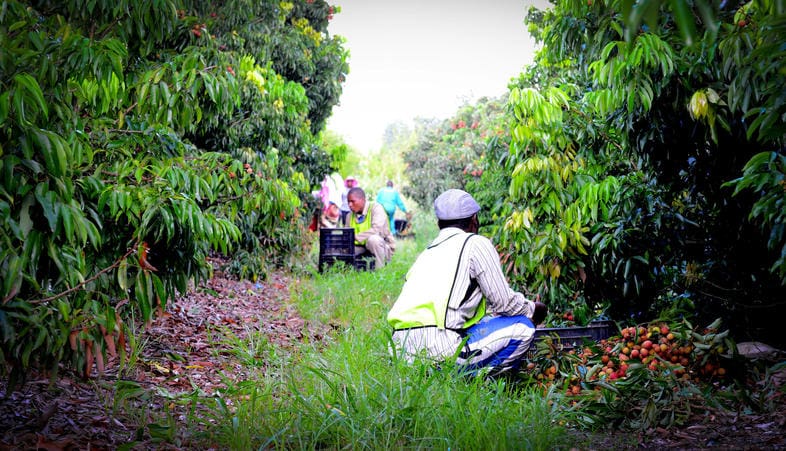
Mpho Ramovha, a smallholder farmer in Ngovhela village near Thohoyandou, tends 16 litchi trees in his backyard. He harvests what he can and sells mostly in his village and also supplies roadside vendors and informal traders who resell to bigger markets.
“This year, my trees have made me happy with so much produce,” Ramovha told Vutivi Business News. “The litchis were ready from 15 November, and I am afraid that if heavy rains come, they will crack and not be buyable by customers as they are fully ripe. I need buyers as soon as possible before the rains,” Ramovha said.
The first buckets of litchis glisten under the Vhembe sun, tempting travellers and traders alike. For some, it is fruit and for others, it is a way to earn and hustle in villages where opportunities are scarce. Along dusty roadsides, litchis have become more than a crop but a currency of resilience.
By now, entrepreneurs, young people, and the youth of villages in Vhembe in north eastern Limpopo, are already selling the juicy fruit by the roadside to people passing on the main road from Sibasa to Nzhelele.
They also sell as far as the towns of Musina, Louis Trichardt, and Wyllies Poort, bringing fresh fruit to markets and communities where it is scarce.
In rural Vhembe District, the litchi season is about backyard trees, buckets filled by hand, and young people selling fruit along roadsides. Some vendors focus on buying fruit in bulk and reselling it across the region.
Mudzunga Muthambi travels from village to village buying buckets of litchis, which she then resells in Musina, Louis Trichardt and Wyllies Poort with her two daughters.
“I buy directly from growers and take the fruit to the towns where there is demand,” she said.
“I buy a 20 litre bucket for R250 and a 25 litre bucket for R300. People in the towns know I bring fresh fruit, so they buy from me quickly. It is hard work, but it pays very well for this December season.”
She added that she also packages litchis into small sachets for profit 10 litchis for R30 and a 1 litre container for R80.
Others are youth entrepreneurs selling directly from the roadside. Lindelani Miriavhavha, 26, sets up her stand along the main road from Sibasa to Nzhelele.
“I sell by the roadside and sometimes go to Wyllies Poort if I have extra fruit,” she said.
“I buy some from villagers, but mostly from trees nearby and some from home. People from the villages and travellers stop by. Some even come from Musina and Louis Trichardt.”
Local vendors also note that the ripening of litchis varies widely across villages. Shonisani Matiba, a vendor in the Tshikunda region, says the litchis in her village outside Sibasa will probably be ready only in December.
“Around our region here, they are not really ready. They are still green because the rain was not enough throughout the region, and there has not been enough heat to speed up the fruit. The trees will be ready in December. For November, only trees in Ngovhela and Duthuni are ready for harvest.”
Monkeys are also a big challenge for entrepreneurs, eating fruit and cutting into profits.
“Monkeys are every farmer’s enemy, they have been eating the litchis since they were green,” Matiba said.
Some vendors also sell to traders from Indian and Pakistani communities who buy crates to resell at big markets — one crate fetching R600.
Informal markets, backyard growers and direct sales to consumers remain a critical part of the Venda fruit economy. Independent buyers and direct to consumer sales allow small vendors and backyard entrepreneurs to participate, even though the sector remains dominated by larger commercial players.
According to the latest SALGA Industry Census 2024, total litchi plantings in South Africa stand at 1,360 hectares, an increase from 1,339 hectares in the 2023 and 2024 season. In the Vhembe district of Limpopo, about 418 hectares of plantings are recorded, indicating a modest but tangible expansion.
At the national level, the updated National Agricultural Marketing Council Fruit Trade Flow Report, Issue 57 (March 2025), shows that litchis remain a notable subtropical export, albeit smaller compared with major fruit categories, contributing export revenue and foreign earnings for the country.
Adding macroeconomic context, leading agribusiness economist Wandile Sihlobo, Chief Economist at Agbiz, recently noted that “South Africa’s agricultural export sector, including subtropical fruit,s is showing resilience in 2025 amid improving port efficiency and strong overseas demand.”
Still, the sector faces systemic risks.
Climate variability, such as drought and heat waves, has in recent seasons damaged flower formation and fruit set, resulting in lower yields, increased fruit drop, sunburn damage, and ultimately reduced supply. These constraints make litchi trade uncertain, particularly for small scale growers and informal vendors relying on backyard harvests.
For rural vendors in Venda, the small scale litchi economy could grow sustainably only if structural support, better access to markets, handling infrastructure, and risk management measures come into play. For now, each crate, bucket and sachet represents both opportunity and vulnerability, dependent on weather, timing and demand.
For rural vendors, litchis remain both a sweet opportunity and a fragile chance.
As Tavhanyedzani Magadani puts it, “It is December and selling this fruit helps almost everyone of us to meet Christmas needs and wants for our families and children.”
Azwi@vutivibusiness.c