















































SMEs are evaluating the implications of the latest inflation rate predictions for their costs, pricing, and access to credit. Inflation is expected to hover around 3 %.
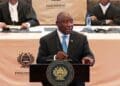
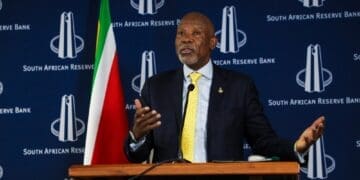
South African Reserve Bank Governor Lesetja Kganyago stated that the new 3% inflation target has enabled the country to enter a low-inflation environment. He is confident it will stay near this level throughout the year.
“There is a print that is coming out later today, we expect to be a slight uptick to 3.6%. But throughout the year, the prints that we expect for each month are that they will all have a 3% handle,” Kganyago said in a Bloomberg TV interview at the World Economic Forum (WEF0 in Davos on Wednesday.
Kganyago added that South Africa is on track to meet its inflation target.
“Inflation across all categories is in line with the target. The low-inflation environment gives policymakers scope to make the policy stance less restrictive, supporting both businesses and households,” he said.
Statistics South Africa’s Consumer Price Index (CPI) figures for December ticked up slightly to 3.6% year-on-year from 3.5% in November. Month-on-month inflation rose by 0.2%. Economists expect CPI to return to the 3% target within the first quarter.
Annabel Bishop, chief economist at Investec, said the rise was due to fuel and seasonal housing and utilities costs.
“A small rise in fuel prices, which added 29 cents per litre, made a modest 0.07% contribution to the CPI’s month-on-month result. Additionally, the usual seasonal influence from housing and utilities also played a role, contributing roughly 0.1%. A silver lining emerges as January’s anticipated fuel price cut of 66 cents per litre is expected to lower inflation by about 0.2% month-on-month. February’s forecast points to an even larger cut of 77 cents per litre, likely to counteract the usual inflationary tendencies observed at the start of the year,” she said.
Food and non-alcoholic beverage inflation remained at 4.4% year-on-year. Global food prices fell by 1.3% in December, while the rand strengthened by 2.4% against the US dollar. These factors helped contain domestic food inflation.
“Going into January, the USD/ZAR exchange rate continued to strengthen, averaging a further 2.4% month-on-month, while global food prices declined by 2.0%. These factors are expected to further moderate inflationary pressures as we move into 2026,” she said.
Frank Blackmore, lead economist at KPMG South Africa, said inflation could rise to 3.5% by November due to base effects from last year.
“While the Monetary Policy Committee is unlikely to cut rates in January, a 25 basis point reduction is anticipated in March, aligning with broader expectations for a proactive monetary approach throughout 2026. This comes despite the inflation rate for 2025 averaging only 3.2%, pushing projections for 2026’s average inflation to about 3.7%,” he said.
Blackmore added that housing and utilities are the main drivers of inflation.
“Electricity price increases at 7.9%, and water at 7% did most of the increase,” he said.
For SMEs, moderate inflation provides clearer visibility on costs and pricing. Stable inflation allows businesses to plan inventory, wages, and supplier contracts with confidence. Slower cost increases protect consumer purchasing power. Retailers, restaurants, and service providers may see steadier demand.
Lower inflation also gives the Monetary Policy Committee room to hold or cut interest rates. This reduces borrowing costs for small businesses. Lower rates can make working capital and expansion financing easier to access, although some businesses still face challenges qualifying for loans.
Sector impacts will vary. Retail and food services benefit from stable prices, while transport and logistics may see lower fuel costs. Agriculture could have more predictable input costs, although global commodity volatility remains a risk. Utilities-heavy businesses may still face rising electricity and water costs.
Despite the stability, SMEs must remain cautious. Imported inputs may be affected by exchange rate swings. Supply chain disruptions could still hit costs. Shifts in consumer demand could affect sales in specific sectors.
“Going into 2026, the strengthening rand and lower global food prices are expected to moderate inflationary pressures,” Bishop said.
Musa Khumalo, owner of KBakers, a small bakery in Johannesburg, said stable inflation gives him more certainty.
“Knowing that prices are unlikely to spike suddenly allows me to plan ingredient purchases, set menu prices, and hire staff with confidence,” he said.
Entrepreneurs who align pricing, operations, and financing with this macroeconomic backdrop will be better positioned to manage costs and sustain cash flow.
Azwi@vutivibusiness.co.za