















































As South Africa marks Workers’ Day today – May 1, 2026, the country’s labour market is increasingly defined by contradiction.
While millions remain unemployed, those with jobs are navigating rising living costs, job insecurity, and a rapidly changing world of work.
For small and medium enterprises (SMEs), this moment presents both pressure and possibility. They are being called on to absorb a growing workforce, retain scarce skills, and adapt to new forms of employment. All while operating within tight financial constraints.
A labour market under strain
According to Statistics South Africa, the official unemployment rate stood at 31.4% in Q4 of 2025, with the expanded rate rising to over 42% when discouraged work-seekers are included. Youth unemployment remains critically high, with more than 50% of young South Africans unable to find work.
This data points to a labour market that is not only struggling to create jobs, but also failing to provide stable and sustainable livelihoods.
Even among those employed, wages are often under pressure, and many workers are increasingly concentrated in low-paying or insecure roles. The result is a growing number of “working poor” individuals who are employed but still unable to meet basic living costs.
The decline of traditional worker representation
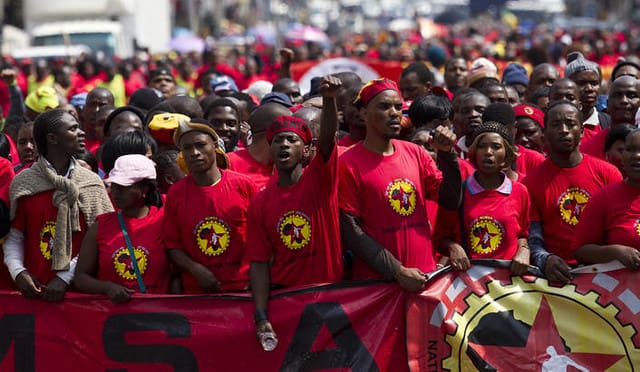
At the same time, the institutions historically responsible for protecting workers are weakening.
Zwelinzima Vavi, General Secretary of the South African Federation of Trade Unions (SAFTU), describes the current state of organised labour as deeply concerning.
“We are weaker than any other time in our recent history,” he says, pointing to a sharp decline in union membership, with only about a quarter of workers now belonging to unions.
He attributes this decline partly to internal failures within unions, including the erosion of worker control, accountability, and close engagement with members.
However, the more fundamental challenge lies in how the nature of work itself is changing.
A new world of work unions are not ready for
South Africa’s labour market is steadily shifting away from traditional, full-time employment towards more flexible and informal forms of work. This includes gig workers, freelancers, platform-based workers, and self-employed individuals.
According to Vavi, unions have not adapted to this shift.
“If we do not have a plan to protect informal and platform workers, you’re out of the game,” he warns.
This gap leaves a growing segment of the workforce without representation or protection, raising concerns about long-term labour standards and worker security.
Economic pressure and social consequences
The broader socio-economic environment is compounding these challenges. High unemployment, inequality, and poverty continue to place significant strain on workers and their households.
Vavi highlights the depth of the crisis, noting the scale of unemployment and the long-term exclusion of many from the labour market.
“When you have millions of people unemployed for long periods, you are working yourself into trouble,” he says.
These conditions, he argues, are contributing to rising frustration and social tension, as economically marginalised groups compete for limited opportunities.
SMEs at the centre of job creation
Against this backdrop, SMEs are playing an increasingly important role in sustaining employment and providing opportunities where larger firms cannot.
However, their ability to do so is constrained.
Kgomotso Ramoenyane, Executive General Manager of Human Resources at Business Partners Limited, says SMEs face growing pressure to retain talent in a competitive labour market.
“Most SMEs cannot compete purely on remuneration due to budget constraints. The question is not how to out-pay corporates, but how to build workplaces that people actually want to stay in,” she explains.
Competing beyond salary
Rather than competing on pay, SMEs are being forced to differentiate themselves through workplace culture, flexibility, and growth opportunities.
Ramoenyane says smaller businesses are uniquely positioned to offer employees a more dynamic work experience.
“In smaller teams, people often take on more responsibility earlier in their careers, gain visibility across the business and see the direct impact of their work,” she says.
She added that this kind of exposure, can be particularly attractive to younger workers seeking meaningful career development rather than just higher salaries.
Investing in people as a retention strategy
Skills development is emerging as another critical tool for SMEs.
“When employees feel that their employer is investing in their growth, it builds loyalty,” Ramoenyane says, emphasising the importance of training, mentorship, and clear career pathways.
She adds that purpose-driven leadership is becoming increasingly important, with workers seeking more than just financial compensation.
“Workers today are looking for more than a payslip, they want to feel valued and understand how their role contributes to the bigger picture.”
The limits SMEs still face
Despite their strengths, SMEs are not a complete solution to South Africa’s labour challenges.
Limited access to funding, economic volatility, and rising operational costs continue to constrain their ability to scale employment and offer competitive benefits.
At the same time, the shift towards informal and flexible work raises questions about the quality and sustainability of jobs being created.