











































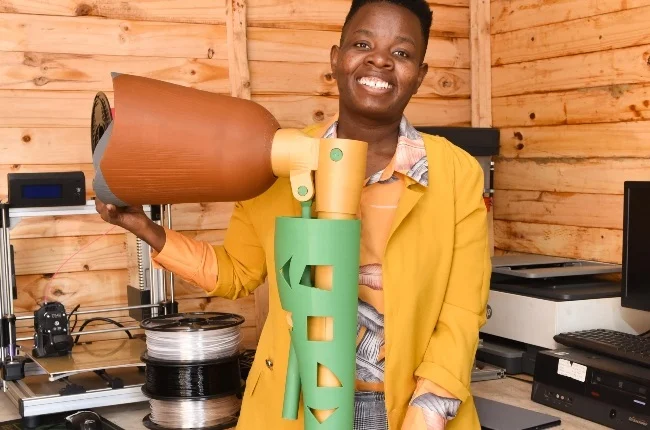
A long wait for care at a hospital gave Sibongile Mongadi an idea for her business.
In that quiet space between uncertainty and need, she encountered a reality that would later shape Uku’Hamba Prosthetics and Orthotics and redefine how she saw access to mobility in South Africa.
A routine consultation for a gum infection in 2018 became an unexpected lesson in inequality. While sitting among patients waiting for treatment, she met an amputee who had been on a waiting list for a prosthetic limb for years.
“It made me realise that some people are not just waiting for healthcare. They are waiting for their lives back,” Mongadi recalls.
Those words would linger far longer than her hospital visit.
She often describes that hospital encounter as the moment she began to question how mobility was distributed in South Africa. Not in theory, but in practice.
“I kept thinking about how long someone can wait for something that changes everything about how they live,” she says.
At 28 years old at the time, she had no formal background in prosthetics manufacturing. What she did have was a growing conviction that the system was not designed to serve everyone equally.
Today, Mongadi is the founder and chief executive of Uku’Hamba Prosthetics and Orthotics, a 100% Black youth and women-owned medical technology company based in Dobsonville, Soweto.
“This is where I am from,” she says. “So this is where the solution should also exist.”
The name Uku’Hamba, isiZulu meaning to walk, is a fitting description for a business built around restoring movement, independence and dignity to people living with mobility loss.
What began as a moment of observation has grown into a small business operating in one of healthcare’s most complex and expensive sectors.
Medicine meets manufacturing
Uku’Hamba Prosthetics and Orthotics operates at the intersection of healthcare, engineering and small business innovation.
Based in Dobsonville, Soweto, the company designs and manufactures prosthetic and orthotic devices for people living with mobility impairments. Instead of relying solely on imported prosthetics, which are often costly and slow to access, Uku’Hamba focuses on localised production using digital design tools and 3D printing technology.
“We are trying to bring the cost down without reducing dignity,” Mongadi explains. “Access should not depend on income.”
The production process begins with digital design and custom modelling tailored to individual patients. Components are then manufactured using 3D printing techniques before being fitted and adjusted according to patient needs. Orthotic devices are also developed to support mobility and rehabilitation.
In a sector where traditional prosthetics can be prohibitively expensive, this model allows for more flexible and affordable solutions.
But innovation, Mongadi is quick to point out, is not just about technology. It is about who gets left out when systems do not evolve.
Medical device manufacturing requires technical expertise, regulatory compliance and capital investment that many small businesses struggle to secure. Uku’Hamba began with limited resources and gradually developed its capacity through persistence and reinvestment.
Despite these challenges, the company has continued to grow, positioning itself within a rising ecosystem of South African health technology entrepreneurs who are localising solutions that were once dependent on imports.
For Mongadi, the impact is measured not in production numbers but in personal outcomes.
“Every time someone stands again, or walks again, that is what matters,” she said.