










































Woolworths is looking to expand its footprint within South African school tuck shops following encouraging pilot projects at private schools in Cape Town.
While the corporate strategy is positioned around health-conscious product choices and parental convenience, the retail giant’s entry into this niche food sector raises significant structural questions regarding the economic survival of independent operators that have traditionally dominated the school catering ecosystem.
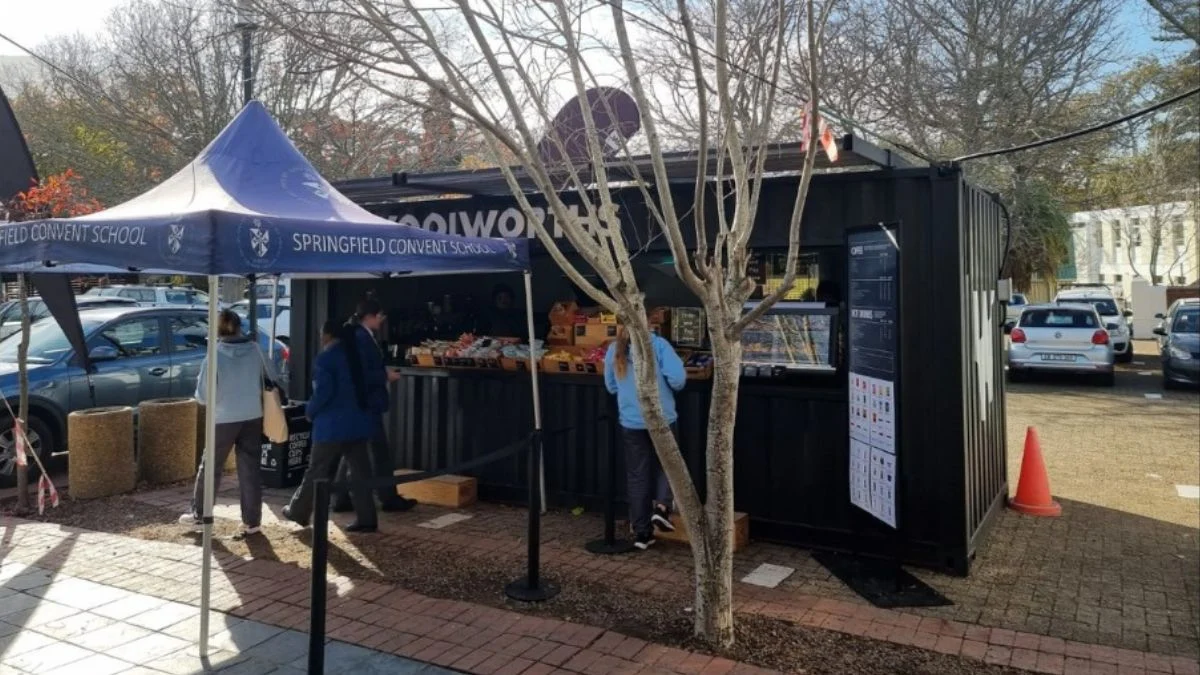
The initial phase of the rollout has seen Woolworths Foods partner with Springfield Convent School in Wynberg and Curro Century City in Cape Town.
The infrastructure models are highly sophisticated; Springfield Convent utilises a converted shipping container, while the Curro facility functions on a fully cashless basis, integrating student bank cards and the Karri financial application to allow parents to pre-plan nutrition and monitor daily expenditure.
Crucially, these pilot kiosks are operated entirely by Woolworths’ internal staff, effectively creating a direct-to-consumer satellite corporate channel within closed school environments.
Outgoing Woolworths CEO Roy Bagattini highlighted the long-term strategic value of the project for the JSE-listed group.
“The tuck shop launch was incredibly successful, and we see an opportunity to introduce young people to the brand via the tuck shops. There has been a lot of demand from schools to improve the quality and health of offerings for pupils”, he said.
Confirming the institutional demand side, Curro Century City management said in a statement defending the pivot to corporate food services, emphasising age-appropriate nutrition and modern transactional models, “thereason for the move was to offer our learners healthy, high-quality food in portions and at prices that are appropriate and targeted to their age group.”
Marginalising independent operators
However, the rapid entry of institutional retail logistics into schools introduces aggressive competitive pressure for local Small and Medium Enterprise (SME) caterers.
Historically, school tuck shops have served as low-barrier-to-entry business opportunities for independent community cooks, family-run micro-enterprises, and localised small-scale commercial caterers who rely on school tenders for consistent, predictable monthly revenue.
Sibongile Mthimkhulu, an independent school canteen operator based in Cape Town, warns that small business owners are being structurally outmatched by corporate logistics.
“We simply cannot compete with a multi-billion rand supply chain. When I buy butter or bread, I pay standard wholesale prices. Woolworths buys at a massive scale that protects its margins. If private and wealthy public schools start outsourcing to big retail giants, local black-owned catering businesses like mine will be wiped out of the education sector completely.”
The disruption also triggers a domino effect further down the localised supply chain. Small-scale food manufacturers who rely on independent tuck shops to stock their products face immediate exclusion from school grounds.
Naledi Ndlovu, founder of a Cape Town-based artisanal bakery that supplies baked goods to several independent school canteens, views the corporate monopoly as a threat to secondary local suppliers.
“As an artisanal baker, my business depends on independent tuck shop operators who are willing to buy from local suppliers. Woolworths does not source its sausage rolls or muffins from neighbourhood bakeries; they use their own centralised, high-volume factories,” Ndlovu said.
“When you replace a local caterer with a corporate kiosk, you aren’t just locking out one shop owner; you are cutting off the local bakers, fresh produce drivers, and egg suppliers who sustained that kitchen,” she said.
Furthermore, there are concerns that this corporate encroachment will not remain isolated to affluent private academies. If the model proves highly profitable, the long-term strategy could reshape the broader public school catering landscape across diverse socio-economic areas.
Lwazi Mthembu, who manages a cluster of public school canteens in suburban and township-bordering regions, argues that corporate entry threatens the informal economic safety net of school grounds.
“In our schools, the tuck shop is how local mothers put their own children through university. We keep our prices low, we understand the community, and we offer credit to students who are struggling. A corporate retailer operates on rigid corporate margins and strict cashless apps. If big retail pushes into public schools under the guise of ‘modernisation,’ they will dismantle a grassroots ecosystem that has kept local families economically alive for decades,” Mthembu argued.