









































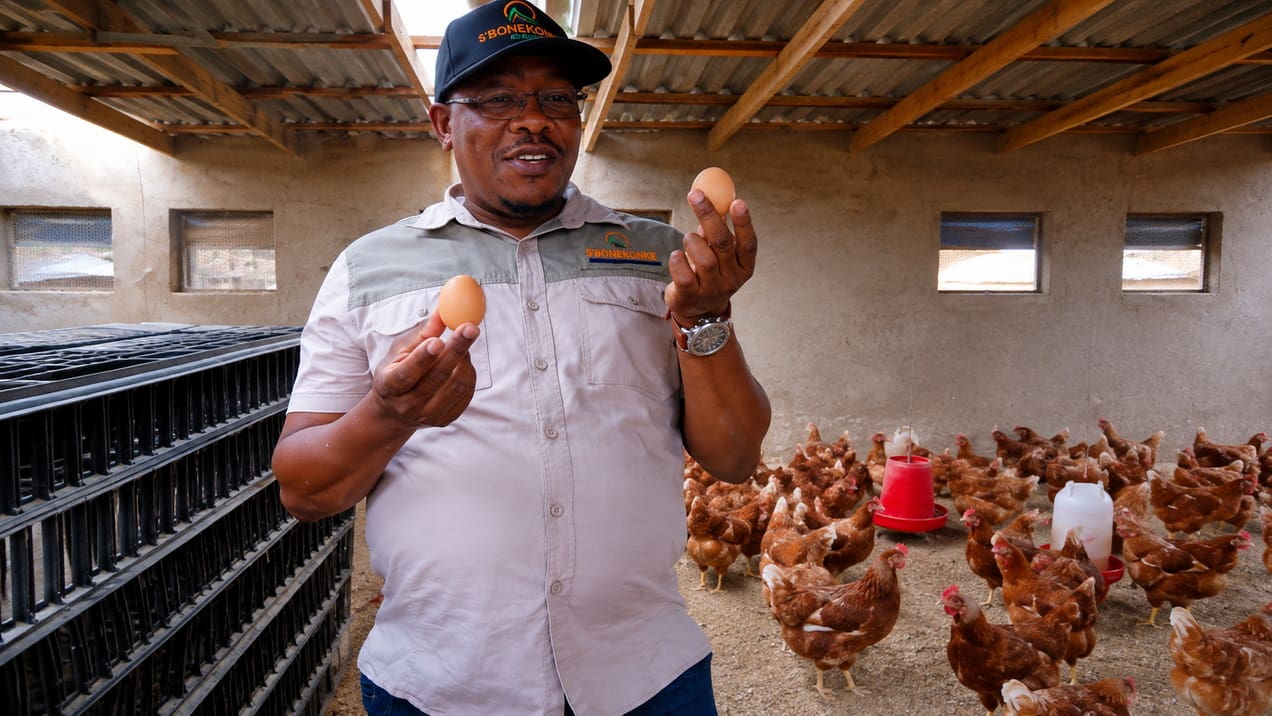
When Xolani Sibiya decided to launch a broiler chicken business, he didn’t turn to a traditional agricultural college—he turned to TikTok.
Lacking a background in farming, Sibiya discovered Sbonekonke Training online, a practical programme that rapidly equipped him with the skills to run a successful poultry operation.
He joined the Sbonekonke Training programme in August last year to gain more knowledge about poultry farming.
“I found the training very educational, especially for someone like me who does not have an agricultural background,” said Sibiya.
During the programme, he received training in both poultry and pig farming. Shortly after completing the training, Sibiya started his own poultry business.
“Sbonekonke Training gave me a better understanding of broiler farming. In just one day, I learnt how to differentiate between broilers and layers, as well as how to manage their feeding, health, production cycle and overall farm management. The training also helped me understand the broiler market and gave me the confidence to start my own business,” said Sibiya.
As more people look to agriculture as a source of income, organisations such as Sbonekonke Training are helping aspiring farmers develop the practical skills needed to build successful poultry and pig farming businesses.
Through its training programmes, Sbonekonke Training is equipping individuals with the knowledge and confidence to contribute to local economic growth while creating sustainable livelihoods.
Sbonekonke Training was established in 2015 by accountant Reggie Mkhize. It is based in Brakpan in the City of Ekurhuleni. The organisation provides practical training aimed at empowering aspiring farmers with the skills needed to succeed in the agricultural sector.
Sbonekonke Training also provides education on animal feed, helping participants understand proper nutrition, feed management and feeding practices.
“We provide training to aspiring and existing farmers on how to start and manage chicken or poultry businesses, with the aim of helping them become commercial farmers. We also teach them how to make their own animal feed from scratch, which can account for about 70% of production costs. This helps farmers reduce their expenses and save money on feed,” said Mkhize.
By combining practical farming techniques with agricultural knowledge, the training aims to empower individuals to establish and grow sustainable farming businesses.
Sbonekonke Group initially operated its training programme only in Gauteng. However, growing demand from aspiring farmers in other provinces, driven in part by the business’s presence on social media, encouraged the group to expand beyond its original base.
Mkhize said social media has played an important role in promoting the training, with many people discovering the programme online, while others are referred by previous trainees.
The training is now also hosted in KwaZulu-Natal, Limpopo and Mpumalanga, with the group planning to extend its programme to Cape Town. This expansion has made the farming training more accessible to people who previously had to travel to Gauteng to attend the programme.

Beyond providing farming skills, Sbonekonke Group has also contributed to youth employment, with 102 young people having been employed through the business.
Despite its growth, Sbonekonke Group faces challenges with customers who book training sessions but fail to make payment. Mkhize said these unpaid bookings affect the business because time and resources are spent preparing for customers who do not honour their appointments.
He said the issue remains a challenge as the business works to provide training and support to aspiring farmers.
As Sbonekonke Group continues to support aspiring farmers through practical training, Mkhize urged those entering the agricultural sector to remain committed and passionate about farming.
He said while agriculture can create opportunities for income and entrepreneurship, it also comes with challenges that require patience and dedication.
“Farming is not easy. You must have passion for farming, not just the love of money. Farming is a very challenging business to be in,” said Mkhize.