














































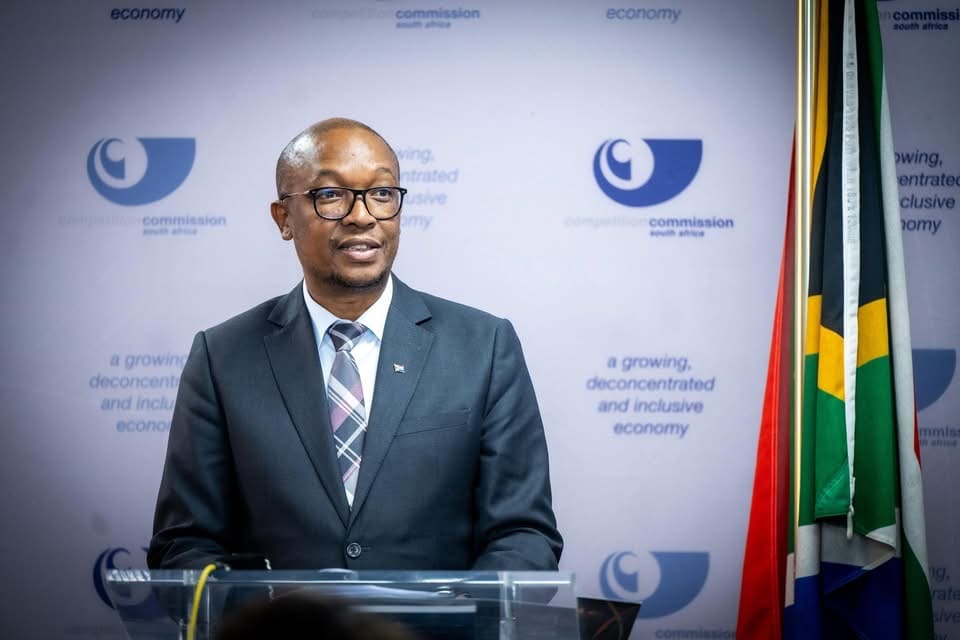
A new Competition Commission report has revealed that South Africa’s economy remains dominated by a small number of large firms, warning that this limits competition and makes it harder for small and medium-sized businesses to grow.
The Competition Commission’s second Concentration Report found that about one-third to half of the country’s 228 economic sectors are still highly or moderately concentrated. This means a few big companies continue to control large parts of the economy, leaving limited space for new entrants.
Trade, Industry and Competition Minister Parks Tau said the findings show the urgent need to change the structure of the economy.
“The report is a much-needed diagnosis and a call to action,” Tau said. He added that government’s industrial policy focuses on “de-concentrating the South African economy” by promoting diversification, decarbonisation and digitalisation.
Economy still dominated by large firms in key sectors
Concentration remains strongest in manufacturing, mining, energy and transport, where a small number of large companies continue to control key value chains.
Energy-related commodities such as oil, gas, coal and iron ore are especially concentrated, while state-owned enterprises still play a major role in electricity and transport infrastructure.
Although the report shows a slight improvement, with a five percentage point decline in highly concentrated sectors since 2017, it warns that change in the structure of the economy is still slow and uneven.
Tau said the continued concentration reflects deep historical inequalities.
“The legacy of apartheid-era market structures is one of the key contributing factors,” he said, adding that ownership and market access remain largely in the hands of established players.
SMEs squeezed out as government pushes reforms
The report highlights ongoing challenges facing micro, small and medium enterprises (MSMEs), which make up 97% of tax-registered firms but contribute only 22% of total turnover.
It also identifies a missing middle, where very few small firms successfully grow into medium-sized enterprises, largely due to barriers in concentrated sectors.
Tau said government policy must go beyond supporting SMEs and actively dismantle barriers that prevent them from scaling.
“The report is correct in emphasising that supporting MSMEs is not sufficient on its own,” he said. “We must simultaneously dismantle the barriers that prevent them from growing.”
He pointed to restrictive market practices such as buyer power, exclusive dealing and predatory pricing, alongside regulatory bottlenecks including licensing and compliance systems.
“These systems have, too often, been weaponised to protect incumbents rather than serve the public interest,” Tau said.
He added that township and rural enterprises must be enabled to compete meaningfully, not remain dependent on dominant firms, calling for urgent implementation of scaling frameworks for small businesses.
For SMEs on the ground, the challenges are already visible.
Nsovo Given Chauke, owner of Mhlengwe Welding Company in Pretoria North, said despite offering fabrication and installation services for structural steel, gates and custom metalwork, accessing large contracts remains difficult due to entrenched procurement networks.
He said growth is limited as large firms continue to dominate supply chains, leaving smaller operators on the margins of formal markets.
In transport, Brian Maswanganye said licensing requirements and long-term contracts held by established operators continue to block entry into logistics value chains, forcing many small firms into subcontracting roles.
Reform pressure builds as SMEs wait for real access
The Competition Commission report confirms that South Africa’s economy remains structurally concentrated despite gradual improvements in some sectors.
While government says reforms will open new entry points and reduce barriers, SMEs argue that meaningful participation in the economy remains limited in practice.
For businesses like Mhlengwe Welding Company, the key question remains whether policy promises will translate into real market access or whether dominant firms will continue to shape who gets to completely.