










































A proposed wind farm outside Makhanda has put the spotlight on whether large renewable-energy developments can translate into lasting opportunities for local businesses, after residents questioned the number of jobs and community benefits that would remain once construction ends.
The proposed Governors Kop Wind Energy Facility will consist of 37 turbines with a combined capacity of 296MW on a 9,386-hectare site about 17km from Makhanda in the Eastern Cape.
At a public meeting in Makhanda on 15 September, residents questioned the project’s potential contribution to the local economy.
Ronnel Kuppen of environmental assessment practitioners Enviro Insight said the construction phase could employ up to 300 people,.
However Kuppen acknowledged that the operational phase would require a much smaller skilled workforce.
A resident challenged the focus on construction employment asking: “How many sustainable jobs will you be creating when you’re done with construction?”
The question is significant for local businesses because renewable-energy projects can create economic activity through more than direct employment, including procurement, enterprise development and spending on services.
However, at the meeting, the project team did not provide a confirmed number of permanent jobs.
Kuppen also said the project envisaged social development spending and a community trust, but could not provide a percentage of equity or a specific revenue figure that would flow to the trust.
Local wind project already supporting SMMEs
Makhanda already provides a local example of how investment in renewable energy can connect with small businesses.
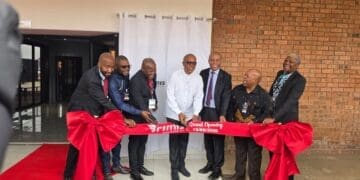
The 94.5MW Wind Garden energy facility, owned by South African company NOA Group, has partnered with the Assumption Development Centre in Makhanda to support local enterprises.
In May, the partnership reported that 10 small businesses had received funding, equipment and services aimed at strengthening their operations and addressing youth unemployment.
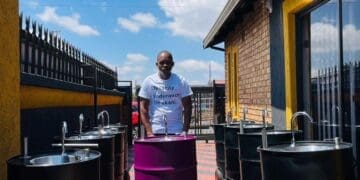
One of those businesses is Jusaqua, a water-distribution company founded by Makhanda entrepreneur Sinethemba Leve.
Leve said equipment funded through the wind farm allowed his business to produce branded water-bottle labels for clients.
“This has resulted in more revenue for the business, and I have been able to increase my employees from three to five,” Leve said.
He added that Jusaqua had subsequently registered as a supplier to Rhodes University and was due to supply water for university events.
Wind Garden’s owner says its community upliftment programme also includes entrepreneurship and SMME development, with funding applications covering those areas.
Angela Harrison, NOA Group’s socio-economic development manager, said working with a locally based organisation has helped the company provide more targeted support.
“Partnering with a locally based organisation like ADC has been invaluable and has allowed for more responsive and meaningful support,” Harrison said.
Different models of community participation
Another existing Makhanda-area wind project demonstrates a different way communities can participate in renewable-energy developments.
The Waainek Wind Farm, which has been operating since 2016, has a community trust that holds 26% of the shares in the project company.
The Makana Winds of Change Community Trust says its mandate is to use the investment for the socio-economic development of communities within a 50km radius of the farm.
This differs from Wind Garden, which has no community equity but has implemented social-investment and enterprise-development programmes.
Wind Garden has also supported education initiatives in Makhanda.
In March, its funding settled outstanding 2025 tuition fees for 10 Rhodes University students, while its broader community programme covers education and skills development, infrastructure, entrepreneurship and enterprise development.
These examples provide different models for measuring the local economic contribution of renewable-energy projects: ownership, enterprise support, procurement, employment and social investment.
For Governors Kop, the precise model and value of the proposed community benefit have not yet been disclosed.
Existing businesses already driving local spending
The debate also comes as Makhanda’s established tourism economy contributes significant spending to local suppliers.
At the Governors Kop public meeting, John O’Brien of Shamwari said four private reserves in the area directly employ roughly 1,200 people.
Kwandwe Private Game Reserve reported spending R88 million with South African suppliers in 2025, including 69 businesses in the Makhanda area.
That spending illustrates the scale of the existing supplier network around the town and why the economic impact of a new development is being considered alongside businesses already operating in the area.
The project’s scoping process will determine whether it advances to a full environmental impact assessment.
The public comment period closed on 28 September, while the Department of Forestry, Fisheries and the Environment will ultimately decide whether the scoping report is accepted.