








































In a township where crime and unemployment often overshadow stories of business success, Kgabo Cars is rewriting the narrative.
The Black-owned automotive business has grown from a local workshop into a professional enterprise that combines vehicle servicing with artisan development, proving that township businesses can compete in South Africa’s automotive industry while creating opportunities for the next generation.
Operating from Soshanguve and Rosslyn, Kgabo Cars has qualified 196 automotive motor mechanic artisans, including 60 women and five cognitively challenged graduates. Several former trainees now run their own businesses, making the company an example of how skills development can drive entrepreneurship and job creation.
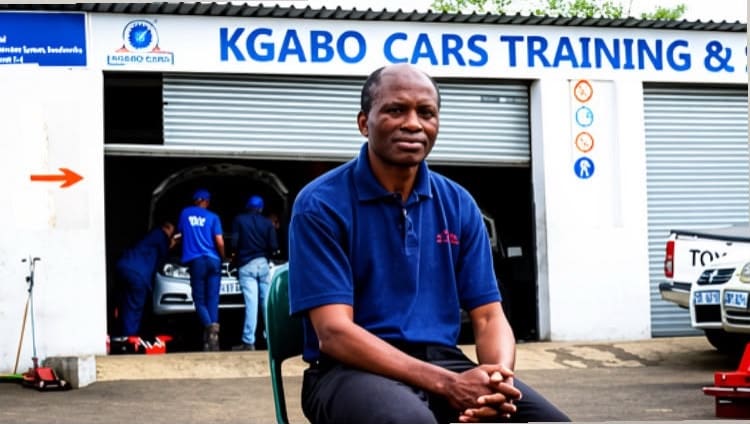
Kgabo Cars was never meant to be just another automotive workshop, according to its founder Dr Isaac Boshomane.
“I wanted to impact the automotive industry by providing professional vehicle servicing, repairs and maintenance while developing our youth holistically and giving them the technical skills to create livelihoods,” he says.
The idea for Kgabo Cars was born while Boshomane was working as an Automotive Motor Mechanic Training Executive at Pretoria West College of Engineering. He approached colleagues about starting a training academy, but they eventually walked away after questioning how long it would take to turn a profit.
“That is when I realised they didn’t see the vision,” he says. “I took my name, Kgabo, and my trade in cars to name it Kgabo Cars.”
Today, the merSETA-approved business combines professional automotive services with a three-year apprenticeship programme that equips young people with technical skills, workplace experience and personal development before they qualify as artisans.
“Our development takes a minimum of three years,” says Boshomane. “We deliberately focus on self-discipline, good behaviour and the right attitude so candidates become professionals who are set apart from others.”
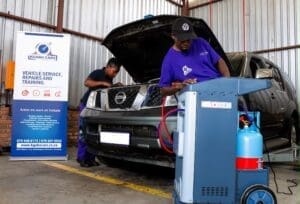
The model has produced measurable results. In addition to qualifying 196 artisans, Kgabo Cars has helped increase female participation in a traditionally male-dominated industry while opening opportunities for young people with cognitive disabilities.
“There is no dustbin for a human being,” says Boshomane.
Boshomane says Kgabo Cars deliberately recruits young people who have struggled to access opportunities, including TVET graduates and neurodivergent learners.
The impact extends beyond employment. Fifteen graduates, including two women, have started their own automotive businesses, with some already employing assistants.
“We are past training for employment,” he says. “We are now training for employment creation, growth, scalability and sustainability.”
Looking ahead, Boshomane wants more graduates to establish their own workshops and eventually operate Kgabo Cars franchises countrywide.
For 20-year-old apprentice Johanna Mogale from Ga-Sekgopo in Limpopo, the programme has opened the door to a career that few women pursue in her community.
“Where I come from, there are no female mechanics. I wanted to prove that women can succeed in this industry too,” she says.
Now 17 months into the three-year programme, Mogale says she has gained the confidence to repair her father’s car and assist motorists with vehicle breakdowns. Her long-term ambition is to own a workshop.
 Qualified artisan Ofentse Ledingoane’s journey reflects the programme’s long-term impact.
After joining Kgabo Cars in 2022, she completed the three-year apprenticeship, qualified as an artisan and was employed by the company.
“I gained technical automotive skills as well as computer, business and communication skills,” she said. “The programme develops you beyond repairing cars.”
One experience has remained with her throughout his journey. On her first day, when transport problems left her stranded, Boshomane fetched her and took her to the workshop, reinforcing the importance of commitment and perseverance.
Ledingoane now encourages unemployed young people to pursue technical careers, saying the skills they gain can help them secure employment or start their own businesses.
Despite funding constraints and bureaucratic challenges, Boshomane remains focused on expanding the business and creating more opportunities for young people.
“Don’t compete with others, beat your own records,” he says. “Create your own space by solving problems for other people. When you remove people’s pain, they will pay you for your solutions.”