













































Grain SA has taken its fight with the Johannesburg Stock Exchange (JSE) to court, warning that the decision on soybean pricing could leave farmers and businesses across the agricultural value chain carrying costs.
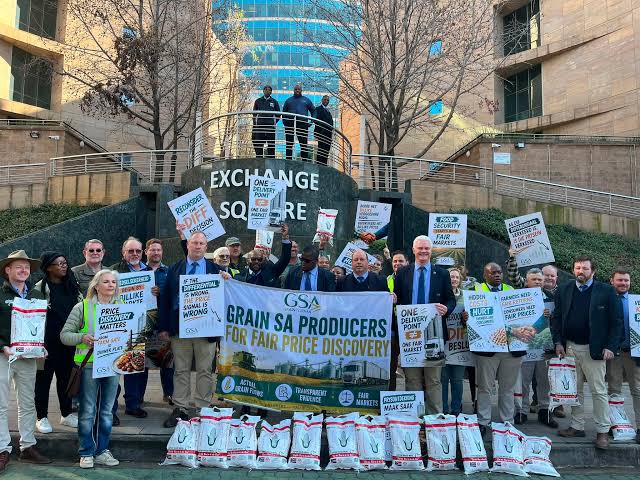
The dispute follows a 13 August protest at the JSE in Sandton against its decision to reject the Multiple Reference Point (MRP) model for soybean futures and revert to the previous pricing methodology.
Grain SA argues that the MRP model is more closely aligned with how soybeans actually move through South Africa’s agricultural market and could reduce the costs built into the pricing system.
According to Grain SA, the more efficient methodology could reduce the calculated differential by approximately R696 million.
The organisation says this raises an important question, “ If the alternative methodology can reduce costs by hundreds of millions of rand, why should that additional cost remain in the system?”
Impact on agricultural businesses
The dispute is not only about a technical pricing mechanism on the JSE.
For farmers and producers operating across the agricultural value chain, changes to commodity pricing can have a direct impact on margins.
Grain SA says farmers already operate under tight margins and cannot simply absorb hundreds of rand per ton in additional deductions.
“If an unnecessary cost is built into the system, somebody ultimately pays for it,” said Grain SA CEO Dr Tobias Doyer.
“The farmer may receive less, costs may move further through the value chain, or both.”
Grain SA questions JSE decision
Grain SA says the JSE has not provided enough quantitative evidence to support its decision to reject the MRP model and the agreed evaluation criteria were not fully addressed.
It argues that soybean pricing should reflect the different regions where the crop is produced, processed and consumed, while limiting unnecessary costs for producers and the wider value chain.
Industry weighs in
Wandile Sihlobo, chief economist at the Agricultural Business Chamber of South Africa, said the call for a fair soybean price discovery method is an important issue for the JSE to consider.
“The farmers must have confidence in the price discovery method, and it must also be a fair and credible approach that considers points of soybean production, processing, and consumption,” said Sihlobo.
He said the farmers’ demonstration at the JSE underscored the importance of the matter to the soybean industry.
“The methodology they propose must be taken seriously,” he said.
Dawie Maree, head of FNB Agriculture Marketing and Information, said he also disagreed with the JSE’s decision.
“It clearly ignored market dynamics,” said Maree.
JSE defends pricing system
The JSE has defended its decision to revert to a single-reference-point system.
In its notice on the decision, the exchange said the move was intended to provide greater consistency, simplicity and predictability for market participants.
The JSE also said it had conducted consultations with stakeholders on the matter.
However, Grain SA maintains that the decision did not address the agreed evaluation criteria for the model and is challenging the decision through legal channels.
Additional costs can move through the agricultural supply chain, affecting processors, traders, logistics businesses and ultimately consumers.
“Every unnecessary rand built into the system has to be carried by somebody,” said Doyer.
“If farmers receive less, their sustainability is affected.”
The organisation said it will continue pursuing the appropriate legal and industry processes to protect producer interests and promote what it describes as a fair market.