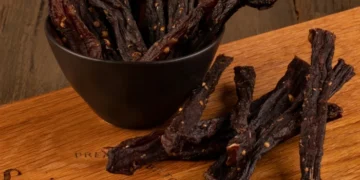










































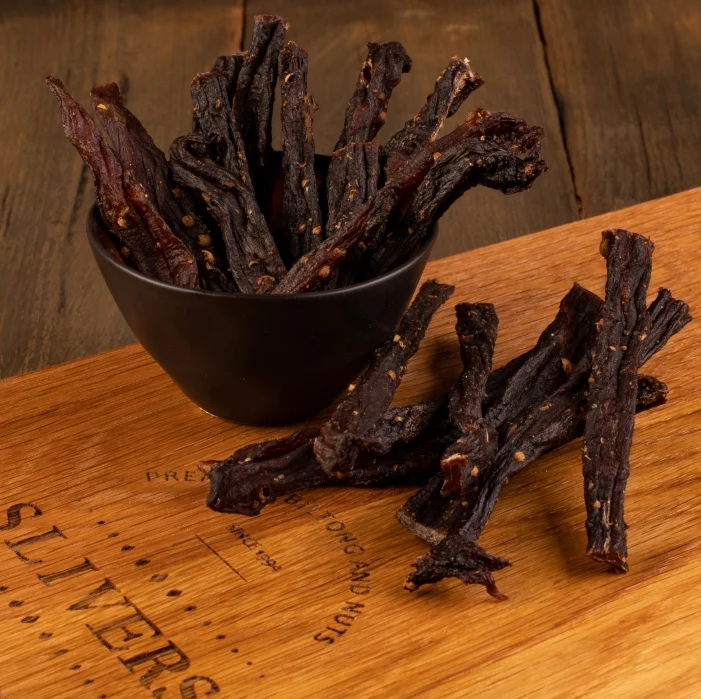
Biltong producers could have more opportunities in overseas markets as international demand grows, while the meat industry considers legal protection aimed at preserving the product’s Southern African identity and production standards.
Charl de Villiers, chair of the Game Meat Industry Association of South Africa (GAMESA), has called for geographical or intellectual-property protection similar to the protection given to products such as Champagne and Rooibos.
The proposal remains an industry idea. Biltong has not been registered as a geographical indication in South Africa, and no government application has been filed.
The proposal comes as the global biltong snack market continues to grow. The market was valued at $1.8 billion in 2025 and is projected to reach $3.9 billion by 2034, growing at a compound annual growth rate of 8.8%.
The growth could give South African biltong producers, including smaller businesses, an opportunity to reach consumers beyond the local market.
Demand grows overseas
Biltong has expanded beyond South African communities, with producers operating in markets such as the United Kingdom.
De Villiers said the product had already established itself internationally.
“Yes, biltong definitely has grown globally. It’s obviously linked to South Africa. Everybody knows that biltong comes from South Africa,” he said.
The international market is being supported by demand for high-protein, low-carbohydrate and minimally processed snacks.
Unlike conventional jerky, biltong is traditionally air-dried rather than oven-cooked and does not contain added sugars. Food companies and startups have also introduced new flavours, packaging formats and proteins such as game and ostrich.
Supermarkets, convenience stores and speciality food retailers have increased shelf space dedicated to premium dried-meat snacks, while online sales have widened access to consumers.
Protecting the standards
De Villiers said any protection should cover how biltong is produced, rather than simply giving South Africa exclusive ownership of the name.
“If we look at the origin of biltong, we can’t necessarily say it’s just a South African product because it’s also produced in Namibia and in other places,” he said.
He supports a Southern African geographical indication covering standards linked to production, authenticity, quality, food safety and traceability.
“I would wholly endorse a Southern African geographic IP for biltong. But we have to protect the standards, more so than just the origin,” he said.
A geographical indication could allow compliant producers to distinguish products made according to agreed standards from products using the name without meeting those requirements.
South Africa already has regulations allowing geographical indications and designations of origin to be registered for agricultural products. Protection in overseas markets would require recognition through relevant trade arrangements.
The proposal could also bring additional compliance costs to producers, particularly businesses wanting to export.
Room for smaller producers
A blanket restriction could be difficult because biltong is already produced outside South Africa, particularly in the UK and Namibia.
De Villiers said the industry should not try to prevent legitimate overseas producers from making the product.
“It will be difficult to say ‘only made in South Africa’ because then we’re taking out all of the other legitimate producers who already exist in the UK,” he said.
Instead, he believes the industry should establish what makes biltong authentic and protect those characteristics.
“The objective should not be to put a fence around biltong, but to make sure its South African identity and the standards travel with it wherever it goes,” he said.
South Africa’s foot-and-mouth disease situation is another challenge, with De Villiers saying it has made exporting biltong in the form familiar to local consumers difficult.
He also believes droëwors, another product strongly linked to Southern African food heritage, could receive similar consideration.