













































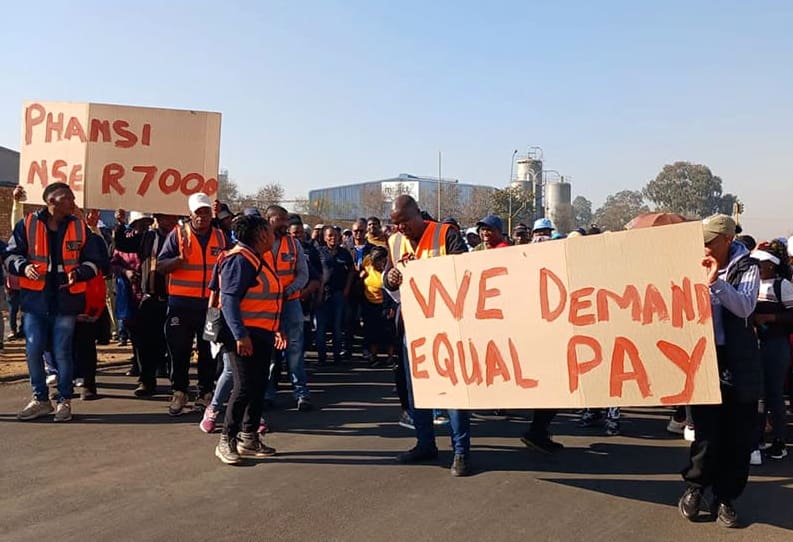
South Africa’s sugar workers are on strike over wages, adding pressure to small businesses operating in and around an industry battling rising imports and declining local sales.
About 6,043 workers are participating in the strike, according to Food and Allied Workers’ Union (FAWU) national sugar sector organiser Sibonelo Mbuyazi. Workers represented by FAWU and other unions are demanding a 13% wage increase, while the Sugar Manufacturing and Refining Employers’ Association (SMREA) has offered 5.4%.
The strike is affecting sugar producers including RCL Foods, Tongaat Hulett, Illovo Sugar South Africa, Gledhow Sugar Company, UCL Company and Umfolozi Sugar Milling. Their operations support a wider network of small-scale growers, transporters, agricultural suppliers and other businesses that depend on the sugar value chain.
Imports displace local sugar
The wage dispute comes as local producers face growing competition from imported sugar.
SA Canegrowers says 94,984 tonnes of sugar were imported between January and May 2026, compared with 55,213 tonnes during the same period last year.
Local sales have also fallen. Figures from the South African Sugar Association show that local sugar sales between April and June 2026 stood at 255,015 tonnes, more than 45,000 tonnes lower than the same period in 2025.
SA Canegrowers chairperson Higgins Mdluli said the impact of imports is being felt throughout the industry.
“Every ton of locally produced sugar displaced by an import is a direct hit to a grower’s income, a mill’s viability, and a rural community’s stability,” Mdluli said.
SASA represents 25,653 small-scale sugarcane growers, meaning the pressure on local production extends beyond the major milling companies.
Workers reject offer
FAWU president Nico Ndima said workers had previously been willing to consider a 6% increase proposed during the bargaining process, but the offer was conditional.
“Currently we are demanding 13%,” Ndima said.
FAWU deputy general secretary Edwin Mabowa said the union rejected linking workers’ wages to the government’s tariff process.
“Workers’ wages cannot be made conditional on government processes,” Mabowa said.
FAWU has said it will return to negotiations if employers make an unconditional offer of at least 7%.
Sugar producer warns of import pressure
Umfolozi Sugar Mill is an independent sugar manufacturer processes cane from a network of more than 1,500 small-scale farmers and produces brown sugar for local and regional markets.
The company has also warned about the impact of imported sugar on local producers.
“We are forced to export more sugar, at a very low world market price, which is way below the cost of production because it is a ‘dumped market’,” Umfolozi Sugar Mill CEO Adrian Wynne said.
“If that trend continues, then nobody can survive.”
ITAC reviews sugar tariff
The import pressure has placed the spotlight on the International Trade Administration Commission of South Africa (ITAC), which is reviewing the sugar tariff mechanism.
The review focuses on the Dollar-Based Reference Price (DBRP) used to determine the variable tariff on imported sugar.
SASA has applied for the DBRP to increase from $680 to $905 per tonne, while the Beverage Association of South Africa has applied for it to be reduced to between $552 and $650 per tonne.
The outcome matters to small retailers and wholesalers that buy sugar for resale, as well as bakeries, confectionery businesses and food manufacturers that use sugar as an input.
RCL Foods has previously raised concerns about the impact of imports on its sugar business.
In its 2026 interim results, the company said inadequate tariff protection and increased deep-sea imports had resulted in imported sugar displacing local market volumes.
The wage dispute remains unresolved, with FAWU maintaining its 13% demand.
“We are willing to go back to the negotiating table and settle at 7%,” FAWU deputy president Nkululeko Mthethwa said.