






































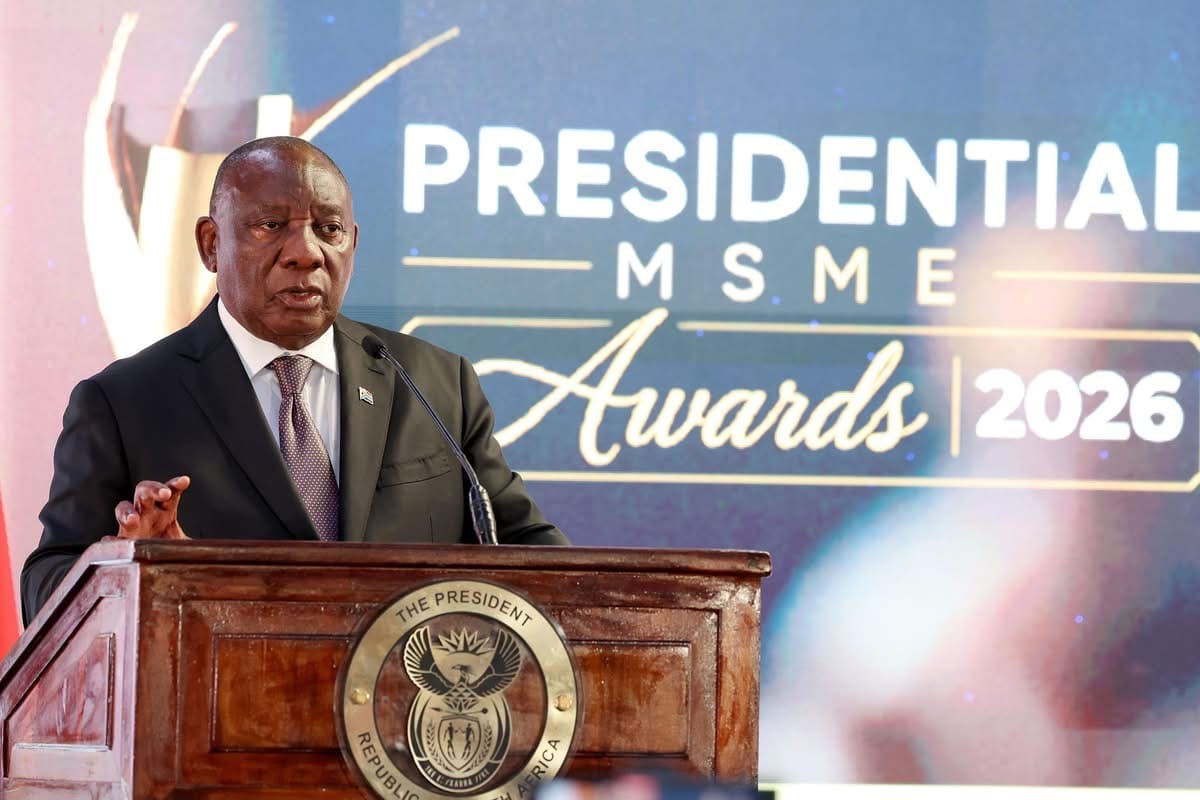
President Cyril Ramaphosa has called for reforms to remove barriers facing micro, small and medium enterprises (MSMEs), saying their growth is critical to expanding production, strengthening local industries and creating jobs.
Speaking at the Presidential MSME and Cooperatives Breakfast in Sandton, Johannesburg, on Thursday, Ramaphosa said entrepreneurs had raised concerns about access to finance, markets, infrastructure and regulatory constraints, which needed to inform government policy.
“I sensed a real urgency to put small businesses on a higher trajectory,” he said.
He said these challenges must feature prominently in the National MSME One Plan, championed by Small Business Development Minister Stella Ndabeni, and the government’s broader reform programme.
“These issues need to be foremost in the ‘National MSME One Plan’ that the Minister is championing, and they need to be part of our broader programme of reforms. Your experiences must continue to inform our policies, our programmes and our decisions,” Ramaphosa said.
Expanding markets and creating jobs
Ramaphosa highlighted the sector’s potential to contribute towards the National Development Plan’s target of creating 11 million additional jobs by 2030, with approximately nine million expected to come from small and expanding firms.
South Africa has around three million MSME owners, presenting opportunities to expand production, strengthen local value chains, increase exports and create employment.
Ramaphosa said he wanted to see more small manufacturers supplying major industrial companies, township enterprises expanding across provinces and the continent, and South African technology companies developing solutions for international markets.
“I would like to see more of our small manufacturers supplying major industrial companies. I would like to see township enterprises grow into businesses that operate across provinces and across our continent. And I would like to see more South African technology companies developing solutions that are adopted around the world,” he said.
He also warned that the R890 billion in investment pledges secured at the South Africa Investment Conference earlier this year would not deliver sustainable economic change if smaller businesses were excluded.
“We will not see sustainable economic change if small businesses are left behind,” he said.
He urged established companies to support MSMEs through supplier development, procurement, mentorship, technology transfer and access to finance.
Ramaphosa also called for entrepreneurs to be better prepared to take advantage of opportunities presented by the African Continental Free Trade Area (AfCFTA), enabling businesses to expand into markets across the continent.
Artificial intelligence opportunities
Ramaphosa identified artificial intelligence (AI), advanced computing and automation as developments creating opportunities for entrepreneurs, but said small businesses needed access to the resources required to participate.
Reflecting on his recent engagements with technology companies and innovators in Silicon Valley, he said innovation thrived where research was supported, investment was mobilised and entrepreneurs could take their ideas to market.
“Access to computing power can be one of the greatest levellers for small enterprises,” he said.
The government is seeking to mobilise public and private resources to finance computing power for small enterprises, attract early-stage venture capital through development finance institutions and partner with universities to establish centres of excellence in artificial intelligence.
“Our ambition is to make South Africa a leading centre for artificial intelligence on the African continent. Small businesses must be at the heart of that ambition,” Ramaphosa said.
He congratulated the entrepreneurs nominated for their achievements, saying their experiences of building businesses despite financial constraints, uncertainty and difficulties accessing markets could offer valuable lessons to other aspiring business owners.
“I hope you will share your knowledge with other entrepreneurs, particularly young South Africans who are thinking of starting their own businesses,” he said.
He said building a stronger entrepreneurial culture would require established business owners to help guide and support the next generation of entrepreneurs.
“We need a society where successful businesspeople become mentors to those who follow.”