



















































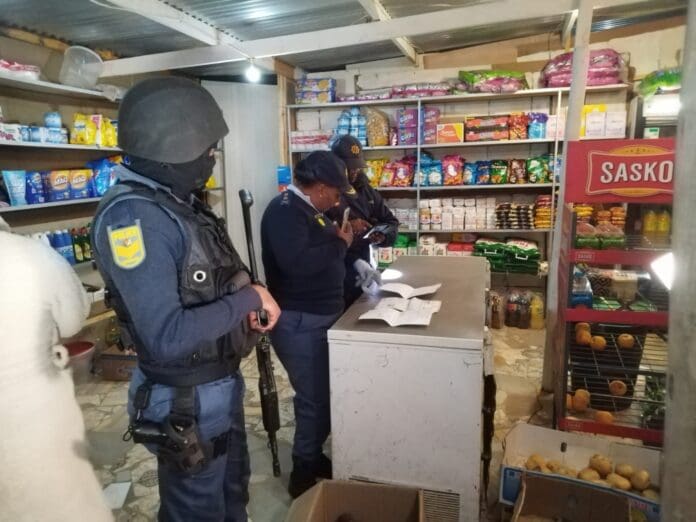
The chilling message was delivered in a letter carried by a child – pay up R1500 to continue running your spaza shop, or else.
“The child told me they were sent by people demanding protection fees,” Mkhize* spaza shop owner, told Vutivi Business News about his harrowing experience.
Extortion and threats are part of the ongoing terror inflicted on businesspeople in many South African townships. Even running a small business like a spaza shop or hair salon now comes with a daily fear of facing extortion rings. Business owners say they are being forced to pay illegal “protection fees” to criminal groups.
This has turned informal economies into enforced revenue zones, where refusal can carry deadly consequences.
Extortion networks are increasingly tightening their grip on Cape Town’s informal economy, with small business owners in townships and informal trading spaces reporting a surge in threats, violent attacks, and demands for “protection fees.”
The crisis has intensified in areas including Delft and Witsand of Atlantis in the City of Cape Town, where traders say they are being targeted regardless of nationality or business size.
What began in previous years as attacks largely directed at foreign-owned spaza shops has now expanded into a broader criminal operation affecting a wide range of informal businesses.
Recently, a 58-year-old woman, Nomancebo Twebe, who sold chicken feet informally for a living, was killed in Delft in an incident believed by residents to be linked to extortion. Her death has deepened fear among traders who say the threats have become increasingly direct and organised.
Spaza shop owner Mkhize explained that when he questioned the child who had come to deliver the letter demanding the R1500 payment further, the situation escalated quickly.
“When I asked who these people were, the child ran to a car. I tried to follow and take a picture, but the car sped off immediately,” he said.
The trader said he was ordered to pay R1,500 “for protection”, a figure he says is impossible for him to afford.
“I don’t have that money. I’m just an informal trader trying to support my family,” he said. “At this point, I can only put my faith in God.”
Community leaders warn of escalation
Community leaders say the violence reflects a coordinated criminal network that is growing in reach and brutality.
“This is not child’s play,” one community leader warned. “We have seen in other communities how small business owners are killed for failing to pay these protection fees. This situation is going to turn deadly if it is not urgently addressed.”
In Witsand, Atlantis, Cape Town, business owners have reported receiving written threats demanding payment of R1,500 as a so-called protection fee. Some of the messages include chilling warnings.
“This is the last warning… if you don’t pay, we kill,” one of the messages reads.
Chairperson of the South African National Civic Organisation (SANCO), Banathi Magani, confirmed that the intimidation campaign has affected multiple traders in the area.
“We received an alarm from the community that they are receiving extortion letters,” he said.
“It started two weeks ago, and it is targeting all businesses around Witsand.”
He added that the pattern of threats followed by violence should not be dismissed as ordinary crime.
“We don’t believe this is robbery,” Magani said. “The community received letters with a deadline, and after that deadline expired, the shooting [of the street trader] happened. That is why we say this is extortion.”
Economists warn of “distorted township markets”
Economists say the rise of protection-fee rackets is not just a crime issue but an economic threat that distorts informal markets and undermines small businesses’ survival.
Lindiwe Mokoena, an independent business analyst, explains that these illegal fees act like a “shadow tax” on the township economy.
“Small businesses already operate on very thin margins. When you add forced payments to criminal groups, it reduces reinvestment, kills growth, and pushes some businesses to close entirely,” she said.
According to Mokoena, the long-term effect is the weakening of township entrepreneurship, job creation, and local supply chains.
“This is not just theft. It is economic capture through violence,” she added.
New traders also targeted
A small business owner said he had only been operating for a few days when he received a threatening letter delivered by a child who claimed to have been sent by extortionists.
Residents say the use of minors to deliver threats has added another disturbing layer to the crisis, suggesting that criminal networks are deeply embedded within the community.
Small business owners are now calling for urgent intervention, warning that the situation is spiralling beyond control and threatening the survival of the township economy.
“We are asking for immediate action from the defence force,” Mkhize said. “As traders are vulnerable. If nothing is done, more lives will be lost to these thugs.”
What the police advise
The South African Police Service (SAPS) says it is actively combating extortion syndicates targeting businesses through specialised teams like the Hawks and intelligence-led operations.
Business people are advised to call the National Extortion Hotline 0800 911 011 to report threats.